What you are looking for?
Basic Procedures Involved InCross Passage Technique
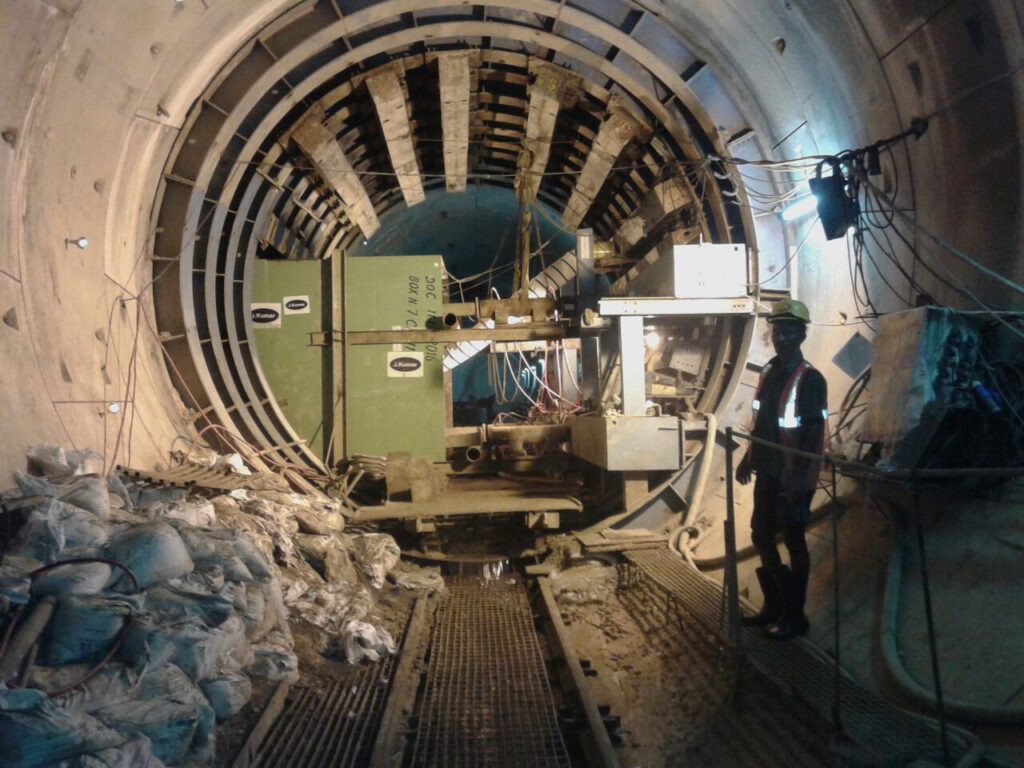
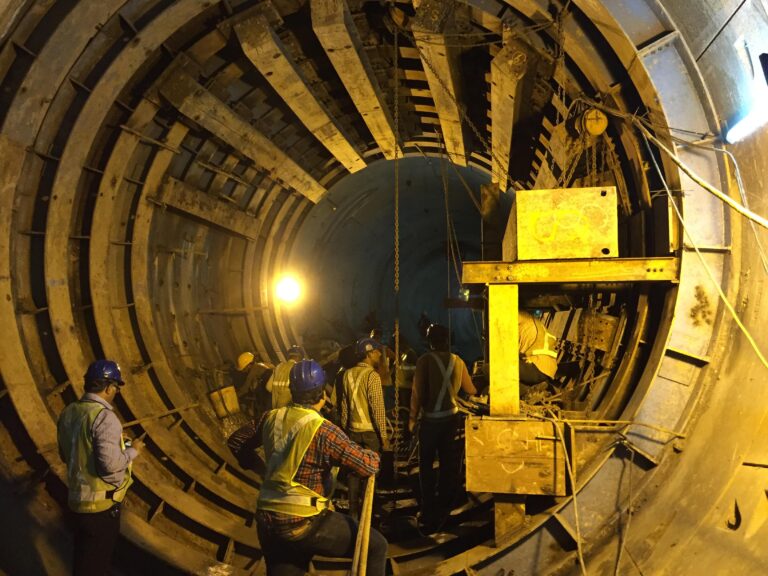
A cross passage is a small passageway built to connect the eastbound and westbound tunnels for maintenance and or emergency purposes. Crews will build these cross passages within the newly built tunnels after the tunnel boring machines have completed their work.
Box pushing is an established method for creating small passages underground without open excavation. It has been used upto 8-10 m depth for construction of subways successfully. SAS INFRATECH have successfully completed construction cross passage by box pushing technique between two adjoining tunnels for emergency and services with the inside clear box dimensions are 2.2 m x 1.8 m upto a depth of 18 m below ground level. Thus overall outer box dimensions works out to 2.9 m x 2.5 m.
| S.No. | Description |
|---|---|
| 01. | Cross passages are provided in long parallel tunnels at regular intervals as safety devices. A detailed survey of the tunnel is carried out and the location of the opening is marked on the tunnel wall. |
| 02. | The area around the opening is strengthened, and fore-polling and time grouting work are done afterward. |
| 03. | Fixing of temporary frame and reaction supports is carried out at the location of the cross passage to enable pushing work. The tunnel lining is cut and removed. |
| 04. | Track is laid in the tunnel for the transfer of boxes from the shaft to the site. |
| 05. | In parallel, boxes are cast on the ground starting with the placement of the cutting edge in the first box and the guide sheet at the end of all boxes, followed by fixing of reinforcement. Shuttering is completed along with the formwork of jacking pockets. Finally, concreting is done and boxes are left for curing. |
| 06. | After all arrangements are ready, boxes are shifted to the access shaft and lowered into the tunnel using cranes. |
| 07. | From the access shaft, the box is carried to the site on track wagons and shifted onto the thrust bed. |
| 08. | Then, drag sheets, jacks, and other pushing arrangements are fixed in position. |
| 09. | Thereafter, pushing is carried out in increments. |
| 10. | Once a box is completely pushed from the thrust bed, another box is placed behind it and pushing is continued, with excavation of soil carried out in parallel. |
| 11. | The process is continued until all boxes are pushed. |
| 12. | The first box enters the opening at the other end. |
| 13. | Finally, jacks between the boxes are removed one by one and the gap is closed successively. |
| 14. | Joints are sealed to prevent the ingress of water into the opening. |
| 15. | Now the cross passage is ready for further work. |